
Entry-Level Cybersecurity Jobs in Canada: Roles, Pay and How to Get Hired
Nov 09, 2026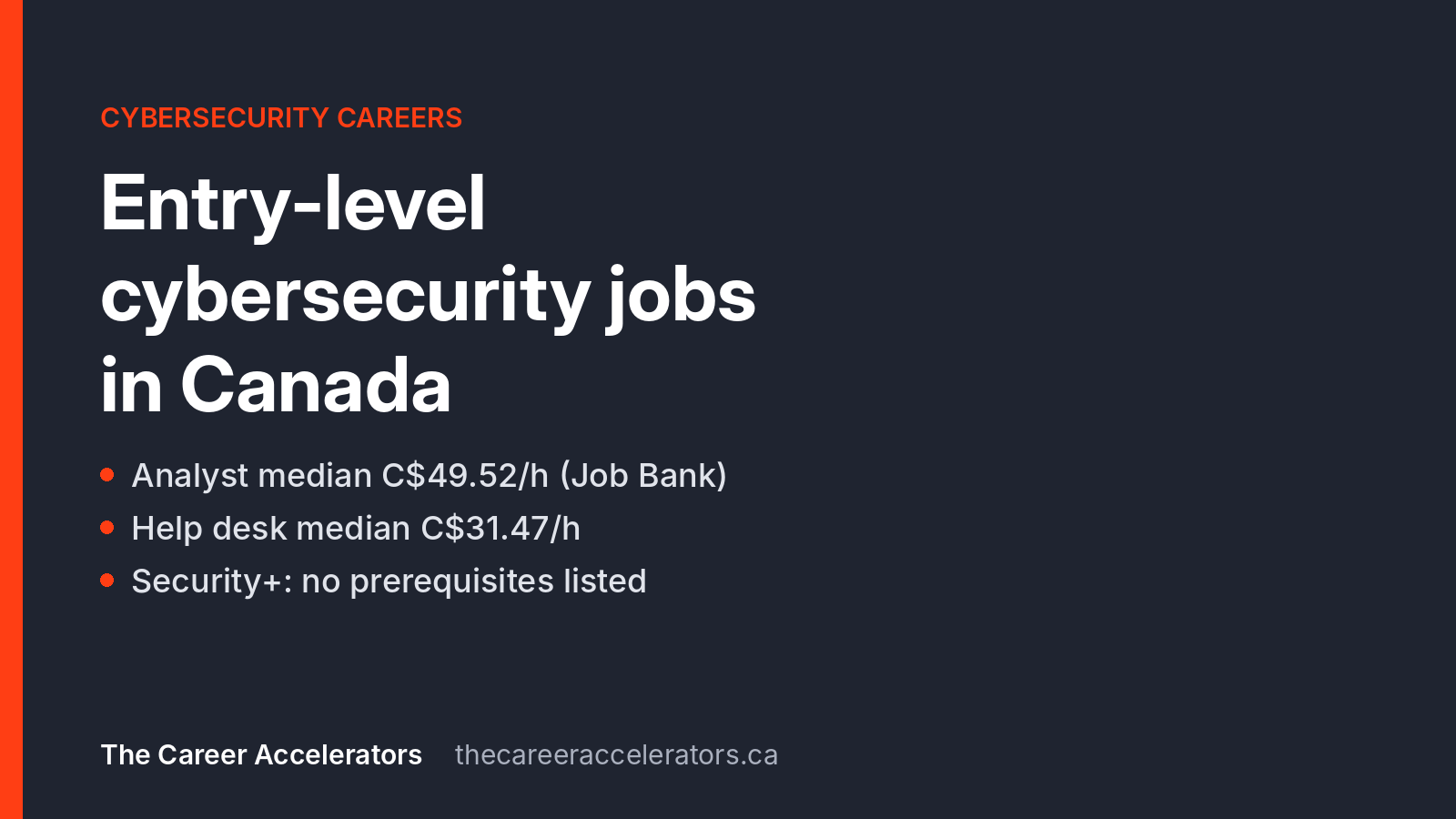
By Stephen Adindu, Lead Coach at The Career Accelerators. Last updated November 2026.
The realistic entry-level cybersecurity jobs in Canada are Tier 1 SOC analyst, GRC or compliance analyst, junior IT security analyst, vulnerability management analyst and identity and access management (IAM) analyst, with IT support or help desk as a common stepping stone. To land one, you need IT basics, one certification that matches the role, such as CompTIA Security+, and proof that you can do the work. Job Bank puts the median wage for cybersecurity analysts in Canada at C$49.52 an hour, and for help desk technicians at C$31.47.
Search for this question and you mostly get job boards and course providers. This guide covers what each first role involves and pays, the certification and project that fit it, and the hiring routes that work in Canada.
Key takeaways
|
What are the realistic entry-level cybersecurity jobs in Canada?
Few employers hire a complete beginner straight into security. ICTC's August 2025 report on Canada's digital economy found junior tech positions becoming less common, with employers leaning toward experienced, specialized staff. The way in is to pick the role where what you already know gives you a head start.
| Role | What you do | Background that transfers |
|---|---|---|
| Tier 1 SOC analyst | Watch alerts, separate real threats from noise, escalate | IT support, networking |
| GRC or compliance analyst | Check controls against policies, laws and standards; track risk | Audit, compliance, risk, business analysis |
| Junior IT security analyst | Run security tools, monitor access, document procedures | System or network administration |
| Vulnerability management analyst | Scan systems, rank weaknesses, chase fixes | Sysadmin, patching, IT operations |
| IAM analyst | Grant, review and remove user access | Help desk, Active Directory, HR systems |
| IT support or help desk | Diagnose and fix users' technical problems | Customer service, any IT exposure |
What does each entry-level cybersecurity job involve?
Tier 1 SOC analyst
A Tier 1 analyst is the first responder in a security operations centre: you watch alerts, decide which are real, follow playbooks and pass complex cases up. The National Occupational Classification (NOC) description of cybersecurity specialists (NOC 21220) covers this work, including watching for intrusions and acting under an incident response plan. Employers look for networking and operating system basics and hands-on time with a SIEM such as Splunk. Our SOC analyst guide covers the tiers in detail.
GRC or compliance analyst
Governance, risk and compliance (GRC) analysts check that security controls match the organization's policies, the law and standards such as ISO/IEC 27001 and the NIST Cybersecurity Framework, and they track the risks that remain. In financial services, OSFI's Guideline B-13 sets out how federally regulated banks and insurers should govern technology and cyber risk. Employers look for clear writing, comfort with frameworks and an eye for missing evidence.
Junior IT security analyst
This is the generalist title. Job Bank lists IT security analyst under NOC 21220, whose duties include running security tools such as anti-virus and threat detection, monitoring access and credentials, and documenting security procedures. The Canadian Centre for Cyber Security's skills framework notes that medium-sized organizations may give IT staff cyber defence and vulnerability assessment duties, so this role can mix the others.
Vulnerability management analyst
You run scanners across servers and laptops, rank the findings by risk, and follow up with the teams who own the fixes until they're patched. Automatic patching of operating systems and applications is one of the 13 control areas in the Cyber Centre's baseline controls for small and medium organizations, and vulnerability management makes up 26% of CompTIA's analyst-level CySA+ exam. Employers look for system administration basics and a scanner you've actually used.
IAM analyst
IAM analysts set up and remove accounts, manage roles and multi-factor authentication, and run access reviews so people only keep the access they need. Monitoring access and credentials is one of the core duties the NOC lists for cybersecurity specialists. If you've reset passwords and managed Active Directory accounts on a help desk, you already know part of the job.
IT support or help desk (the stepping stone)
Help desk isn't a security job, but it's a common way to get the IT experience security roles ask for. Job Bank groups help desk technicians with user support technicians (NOC 22221), who diagnose and fix users' problems, advise and train them, and keep a log of solutions. Once you're in, ask to handle phishing reports, account lockouts and access requests so your CV shows security work.
How much do entry-level cybersecurity jobs pay in Canada?
These are Job Bank's national hourly wages, updated 19 November 2025, converted to yearly pay at 37.5 hours a week for 52 weeks. The low and high figures are roughly the 10th and 90th percentiles of everyone in the occupation, and Job Bank says its wages don't account for experience, so the low figure is the bottom of the range, not a starting salary.
Job Bank has no line for SOC, vulnerability management or IAM analysts, so this guide uses the cybersecurity analyst line as a stand-in. It has no GRC line either, so GRC gets two stand-ins: the cybersecurity analyst line for security risk work, and Job Bank's systems auditor line for audit-style work. Systems auditor is one title in NOC 21222, information systems specialists, a broad group that also includes IT auditors, systems analysts and IT consultants, and the wage covers the whole group.
| Role | Job Bank line used | Low / median / high (hourly) | Median per year |
|---|---|---|---|
| Junior IT security analyst | IT security analyst (NOC 21220) | C$30.00 / C$49.52 / C$72.12 | About C$96,600 |
| Tier 1 SOC, vulnerability management and IAM analysts; GRC (security risk side) | Stand-in: cybersecurity analyst (NOC 21220) | C$30.00 / C$49.52 / C$72.12 | About C$96,600 |
| GRC or compliance analyst (audit side) | Stand-in: systems auditor, one title in NOC 21222 (information systems specialists) | C$28.85 / C$46.15 / C$68.68 | About C$90,000 |
| IT support or help desk | Help desk technician (NOC 22221) | C$20.50 / C$31.47 / C$49.00 | About C$61,400 |
At the low end, C$30.00 an hour is about C$58,500 a year, and C$20.50 about C$40,000. Our SOC analyst guide shows provincial medians.
Where are the cybersecurity jobs in Canada?
Job Bank expects cybersecurity specialists to face a moderate risk of labour shortage nationally from 2024 to 2033. Its three-year outlook for 2025 to 2027 varies by province, and help desk looks different again.
| Province | Cybersecurity analyst (NOC 21220) | Help desk technician (NOC 22221) |
|---|---|---|
| Nova Scotia | Good | Moderate |
| Quebec | Good | Limited |
| Alberta | Moderate | Moderate |
| British Columbia | Moderate | Limited |
| Manitoba | Moderate | Moderate |
| Saskatchewan | Moderate | Moderate |
| New Brunswick | Moderate | Moderate |
| Ontario | Limited | Limited |
Job Bank rates Ontario Limited because it expects steady employment and few retirements; there are still jobs, but bring strong proof. Job Bank also says cybersecurity specialists work for IT consulting firms and in IT units across the public and private sectors. Our advice: approach government, banks and other regulated employers, and IT consulting firms directly.
Which certification fits each first role?
One certification, matched to your target role. Our cybersecurity analyst guide explains where the advanced certifications, which need years of experience, fit later.
| First role | Certification | Experience rule |
|---|---|---|
| SOC, junior IT security, vulnerability management | CompTIA Security+ | No prerequisites listed; recommended experience below |
| GRC or compliance | CompTIA Security+ or OCEG GRCP | GRCP: no work experience or degree required. It's included in OCEG's All Access Pass (see OCEG's site for the price). |
| IAM | Microsoft SC-900, then SC-300 | SC-900 has no formal prerequisites; Microsoft says you should know Azure and Microsoft 365. You renew SC-300 every 12 months, free, by passing an online assessment. |
| Help desk | CompTIA A+ | Two exams, Core 1 and Core 2. No prerequisites listed; CompTIA recommends 12 months in an IT support role. |
| Any role, as a first credential | ISC2 Certified in Cybersecurity (CC) | No work experience required |
Security+ V8 (SY0-801) is available from 17 November 2026, and the English V7 exam (SY0-701) stays available until 11 June 2027; until then you can take either. For V7, CompTIA recommends Network+ and two years in a security or systems administrator role; for V8, two years of hands-on work as a security administrator.
According to CompTIA, no other IT credential shows up in as many tech support job ads as A+, which is why it suits the help desk route.
How do you build a home lab and portfolio that gets interviews?
Build proof for one role, not for everything. A laptop that can run two or three virtual machines is enough, and the core tools cost nothing:
- Splunk Free: indexes up to 500 MB of data a day but has no alerting. A new install runs as a 60-day Enterprise trial, which includes alerting, and you then switch to the Free licence.
- Wireshark and Nmap: free, open-source tools for reading network traffic and for network discovery and security auditing.
- Greenbone Community Edition (OpenVAS): open-source vulnerability scanning. Tenable's free Nessus Essentials is now a 30-day licence for up to 5 IPs.
- GRC frameworks: NIST's Cybersecurity Framework 2.0 (February 2024), with six functions: Govern, Identify, Protect, Detect, Respond and Recover. Add the Cyber Centre's baseline controls.
Only scan machines you own or have written permission to test.
| Target role | Portfolio project |
|---|---|
| Tier 1 SOC analyst | Send Windows and Linux logs to Splunk, simulate a burst of failed logins, and write it up as a ticket: alert, checks, verdict, next step. |
| GRC or compliance analyst | Assess a fictional 40-person firm against the Cyber Centre's 13 baseline control areas, map the gaps to NIST CSF 2.0 functions, and build a risk register. |
| Junior IT security analyst | Harden a Windows or Linux virtual machine, scan it before and after, and document each change. |
| Vulnerability management analyst | Scan your lab with Greenbone, rank the top five findings, and write a one-page remediation plan with owners and deadlines. |
| IAM analyst | Design a joiner, mover and leaver process for a fictional team, with role definitions and a quarterly access review. |
| IT support or help desk | Write a short knowledge base of fixes, including one article on spotting and reporting phishing. |
Write each one up like a work document: problem, actions, evidence, result, next step. Link them from your CV.
How do you get hired through government, banks, co-ops and apprenticeships?
Federal government
- Screening comes first. A valid security status or clearance is a condition of employment with the Government of Canada. The levels are reliability status, Secret and Top Secret, and even the basic checks include criminal record and credit checks.
- Preference. In external advertised processes, eligible veterans come first, then Canadian citizens and permanent residents who meet the essential qualifications.
- Students. The Federal Student Work Experience Program takes one application into a year-round inventory that more than 200 departments and agencies draw from. Co-op students apply through their school's co-op office, if their program is on the Public Service Commission's validated list.
- Security agencies. CSE, home of the Cyber Centre, hires Canadian citizens only; most roles need Enhanced Top Secret clearance with a polygraph, and the process can take 12 to 18 months.
- Indigenous applicants. The IT Apprenticeship Program for Indigenous Peoples is a 24-month paid entry-level IT term, listed as ongoing hiring.
Banks and other regulated employers
Federally regulated banks, insurers and trust companies work under OSFI's Guideline B-13, which covers technology and cyber risk governance, technology operations (including patch management) and cyber security: the areas GRC, vulnerability management and IAM teams work in. RBC, for example, lists co-ops, internships and new graduate rotational programs. If you're not a student, our advice is to apply directly to analyst roles on banks' security teams.
Co-ops, bridging programs and apprenticeships
- Student placements: if you're a student, small employers can claim a wage subsidy through ICTC's WIL Digital program for hiring you: up to $7,000 (the rate depends on the student; check ICTC's eligibility page).
- NPower Canada Network Security Professional: free, 15 weeks; for people with a related diploma or degree and a year of related experience who face unemployment, underemployment or financial barriers, with English at CLB 7 to 8 for non-native speakers.
- ACCES Employment Cybersecurity Connections: free, 8 weeks, for internationally trained IT professionals who are permanent residents, Convention refugees or naturalized citizens.
Our guide to cybersecurity apprenticeship programs in Canada and the US has the full eligibility rules for these and other programs.
A step-by-step plan to land your first cybersecurity job
| 1. Pick one target role Choose the role your current experience supports best. |
| 2. Close the IT basics gap Networking, Windows and Linux. With no IT experience at all, a help desk job is a valid first move. |
| 3. Earn one matching certification Use the certification table for your role. |
| 4. Build two proof projects Pick from the portfolio table and write them up properly. |
| 5. Apply through several channels Postings, government and bank programs, bridging programs and referrals, all at once. |
| 6. Prepare for technical interviews Practise explaining your projects, then work through our cybersecurity interview questions. |
How our cybersecurity course fits these roles
Our cybersecurity course is a 12-week coaching program delivered live online, and its main focus is governance, risk and compliance (GRC), so it fits the GRC and compliance route most directly. This program includes a 12-week live project with tasks such as security risk assessments, policies and compliance checks; training in the NIST Cybersecurity Framework and ISO/IEC 27001; hands-on Splunk, Wireshark, Nmap and Nessus; Security+ and GRCP preparation; and mentorship, CV review, interview preparation and references based on your live project work. No prior IT experience is required. Aiming for a SOC role instead? Add the Splunk project from the portfolio table.
Entry-level cybersecurity jobs FAQs
Can you get an entry-level cybersecurity job in Canada with no experience?
It's possible but hard, because junior roles are less common than they were. Most people need a stepping stone, such as help desk, a co-op, a bridging program or a live project.
Which entry-level cybersecurity job is easiest to get into?
It depends on your background. IT support experience suits Tier 1 SOC or junior security roles. Audit, compliance, risk or business analysis experience suits GRC. With neither, help desk is the most realistic start.
Do you need a degree for an entry-level cybersecurity job in Canada?
The NOC says cybersecurity specialist roles usually ask for a bachelor's degree or a college program in IT or a related field, and help desk roles a college program.
Can permanent residents get federal cybersecurity jobs?
Yes, for most federal jobs. Permanent residents share the same preference as citizens in external advertised processes. Some security agencies, such as CSE and CSIS, hire Canadian citizens only.
Stephen's tip: Choose your first role before you choose a course or certification. Write the role at the top of your CV and make every project on it prove that one job.
Ready to start your cybersecurity career?
Our cybersecurity course combines live training, a 12-week live project and Security+ preparation, with a focus on GRC roles. Book a free call and we'll help you choose the first role that fits your background.
Related reading: what a SOC analyst does, how to become a cybersecurity analyst and cybersecurity apprenticeship programs in Canada and the US.
Sources
- Job Bank wages for cybersecurity analyst, IT security analyst, systems auditor and help desk technician, and the wage methodology, for pay
- Job Bank outlooks for cybersecurity analysts, in Ontario and for help desk technicians, and the cybersecurity analyst summary, for prospects and employers
- NOC profiles 21220, 21222 and 22221, for duties, titles and requirements
- ICTC: Digital Economy Pulse, August 2025, for junior roles
- CompTIA Security+ V7, Security+ V8, A+ V15, A+ overview and CySA+ V4; OCEG; ISC2 CC; Microsoft Learn SC-900 and SC-300, for certifications
- Canadian Centre for Cyber Security baseline controls and skills framework, and NIST CSF 2.0, for frameworks and control areas
- Splunk Free, Wireshark, Nmap, Greenbone Community Edition and Nessus Essentials, for home-lab tools
- OSFI: Guideline B-13 and RBC: Students, for banks
- Government of Canada security screening, PSC preference for appointment, FSWEP, co-op program, CSE hiring and CSIS jobs FAQ, for federal routes
- Digital Talent Strategy review, PSC: jobs for Indigenous people and the program Q&A, for the IT Apprenticeship Program for Indigenous Peoples
- ICTC: WIL Digital, NPower Canada and ACCES Employment, for co-op and bridging programs
