
What Does a Project Coordinator Do? Salary, Skills and How to Become One in Canada
Oct 31, 2026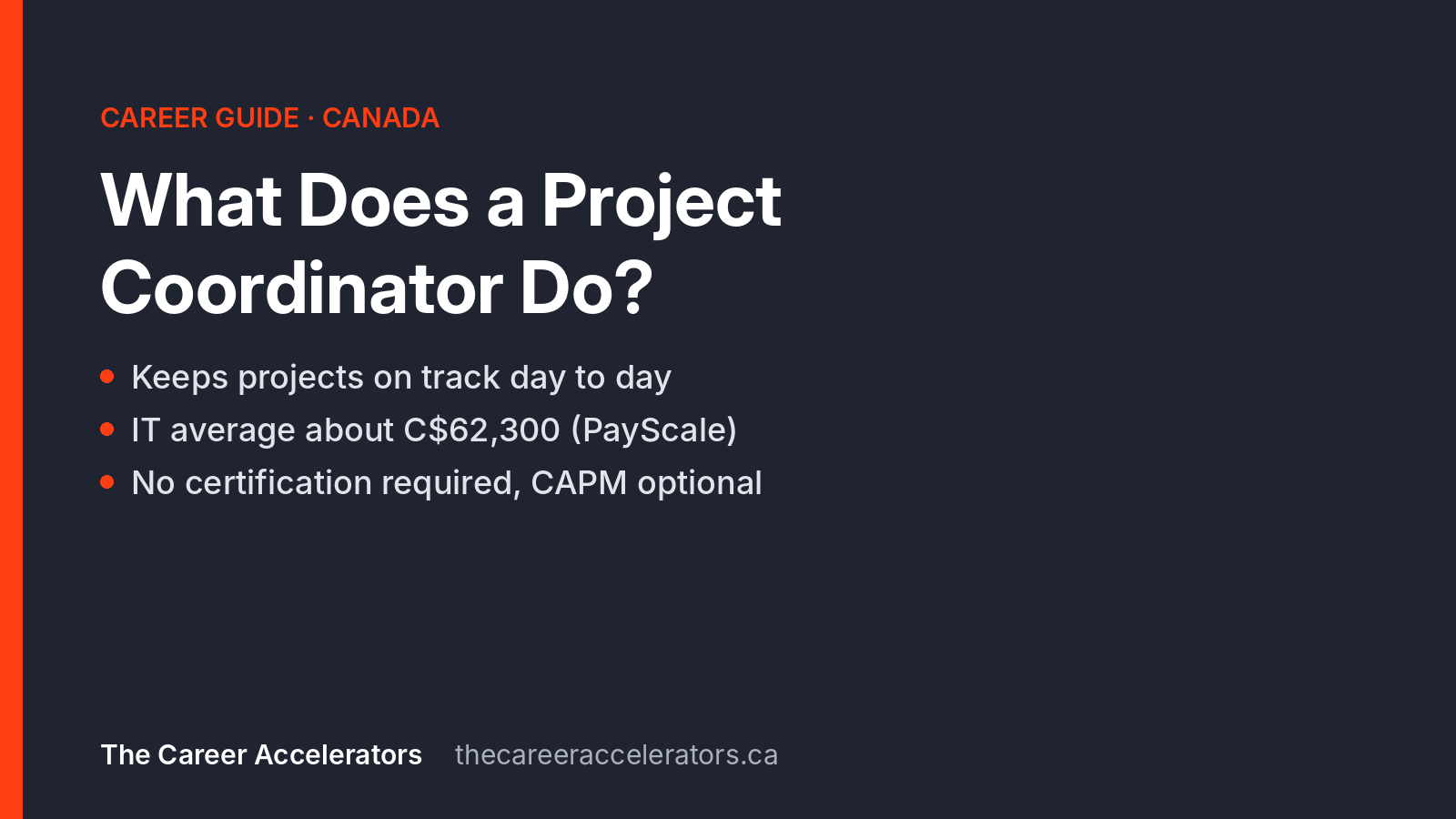
By Stephen Adindu, PMP, PRINCE2, Lead Coach at The Career Accelerators. Last updated October 2026.
A project coordinator keeps a project running day to day: tracking tasks and deadlines, organising meetings, updating schedules and reports, and making sure the right people have the right information. It's one of the most common entry points into project management. You don't need a licence, and skills from admin, operations, customer service or events work transfer directly. In Canada, IT project coordinators with project management skills earn about C$62,300 on average, according to PayScale.
This guide covers what the job involves, what it pays, the skills and tools employers ask for, whether you need a certification, and a step-by-step way to land your first role.
Key takeaways
|
What does a project coordinator do?
The project manager owns the plan and the decisions. The coordinator keeps the machinery running. A typical week includes:
- Tracking work: updating the schedule, chasing task owners, and flagging anything slipping.
- Running meetings: booking them, preparing agendas, taking notes and following up on actions.
- Reporting: drafting weekly status reports and dashboards for the project manager and sponsors.
- Keeping logs: maintaining the risk, issue, decision and change logs (often called the RAID log).
- Handling documents: keeping project files, version control and approvals in order.
- Working with suppliers and budgets: tracking purchase orders, invoices and spend against budget.
In IT projects, the role can go further. A remote IT project coordinator posting on Canada's Job Bank in August 2026 also asked for client meetings, writing up technical requirements, documenting test results and resolving conflicts.
Project coordinator vs project manager
| Project coordinator | Project manager | |
|---|---|---|
| Main job | Keep the plan on track day to day | Own the plan, scope, budget and outcome |
| Decisions | Raises issues and options | Makes the call, or takes it to the sponsor |
| Typical experience | Entry level to a few years | Several years of leading projects |
| Common certification | CAPM (optional) | PMP or PRINCE2 |
How much do project coordinators earn in Canada?
PayScale reports an average base salary of C$62,303 for IT project coordinators in Canada who list project management skills. Most earn between about C$50,000 and C$78,000. That's based on 71 salary profiles, last updated in February 2025, so treat it as a guide rather than a firm figure. Pay varies with industry, city and the size of the projects.
For a real-world example, that August 2026 Job Bank posting offered C$25 to C$35 an hour, and asked for two to three years of experience and a degree or equivalent experience.
What skills and tools do employers ask for?
| Skill area | What it looks like on the job |
|---|---|
| Organisation | Keeping schedules, logs and files current without being chased |
| Communication | Clear status updates, concise meeting notes, polite but persistent follow-up |
| Project basics | Understanding scope, schedule, risks, issues and change control |
| Agile awareness | Knowing how sprints, backlogs and stand-ups work, since many IT teams use them |
| Tools | Excel, MS Project, Jira, Confluence, SharePoint and Microsoft Office |
Do you need a certification to be a project coordinator?
No. But if you're changing careers, a certification shows you've learned the fundamentals. The usual choice is PMI's CAPM (Certified Associate in Project Management). PMI lists project coordinator among the roles it's designed for.
| CAPM at a glance | Details |
|---|---|
| Eligibility | Secondary diploma or equivalent, and 23 hours of project management education. No experience needed. |
| Exam | 150 questions (135 scored) in 180 minutes, at a Pearson VUE centre or online |
| What it covers | Project management fundamentals (36%), business analysis frameworks (27%), Agile (20%) and predictive methods (17%) |
| Keeping it | 15 professional development units every three years |
The PMP isn't an entry-level option. With a bachelor's degree, it needs 36 months of experience leading projects within the last 10 years, plus 35 hours of training (an active CAPM covers the training). Coordinating projects is a good way to start building that experience.
How to become a project coordinator, step by step
| 1. Learn the basics Scope, schedule, RAID logs, status reporting, Agile and predictive methods. |
| 2. Learn the tools Excel, MS Project or a similar tool, and Jira for Agile teams. |
| 3. Build proof Run a real or practice project and keep the plan, logs and reports as samples. |
| 4. Reframe your CV Turn past admin, events or operations work into coordination achievements. |
| 5. Apply widely Also look at project administrator, PMO assistant and junior project analyst roles. |
Turn what you've already done into coordination experience
Many people coordinate projects without the title. If you've planned an office move, run an event, rolled out a new process or managed suppliers, you've done coordination work. Describe it in project language: what the goal was, what you tracked, who you kept informed, and what got delivered on time.
How we help people become project coordinators at TCA
Our project management coaching program runs live and online over 12 weeks and includes a live project. You'll work with MS Project, Jira, Trello, Confluence and SharePoint, and get one-to-one mentorship, CV review and interview preparation aimed at project coordinator and entry-level project manager roles.
One TCA graduate went from no work experience to a project coordinator role. Read their story.
Project coordinator FAQs
Is project coordinator an entry-level job?
It can be, but requirements vary by employer. The IT posting above asked for two to three years of related experience, so check each posting and lead with your transferable coordination work.
Do I need a degree?
Not always. The Job Bank posting above, for example, accepted a degree or equivalent experience.
Is the CAPM worth it for a project coordinator?
It helps career changers show they know the fundamentals, and PMI designed it for roles like this. It isn't required.
How long until I can become a project manager?
It varies. Many coordinators step up after a few years of handling more of the plan themselves. Keep a record of the projects you help lead, since the PMP later asks for that history.
What's the difference between a project coordinator and a project administrator?
Titles overlap. Administrator roles usually lean more toward documents and logistics, while coordinators track the schedule and follow up with the team more.
Ready to start your project coordinator career?
Our project management coaching program combines training, a live project and job search support. Book a free call and we'll look at how your experience can transfer.
Related reading: how to become a project manager and why communication is the cornerstone of project management.
Sources
- PayScale: IT project coordinator salary in Canada, for the average and range (71 profiles, updated February 2025)
- Job Bank: remote IT project coordinator posting (Convergine Corp, advertised August 2026, now closed), for example duties, requirements and pay
- PMI: CAPM certification, for eligibility, exam format, domains, renewal and target roles
- PMI: PMP certification, for the PMP experience requirement
