
What Does an IT Project Manager Do? Skills, Pay and How to Become One in Canada
Nov 05, 2026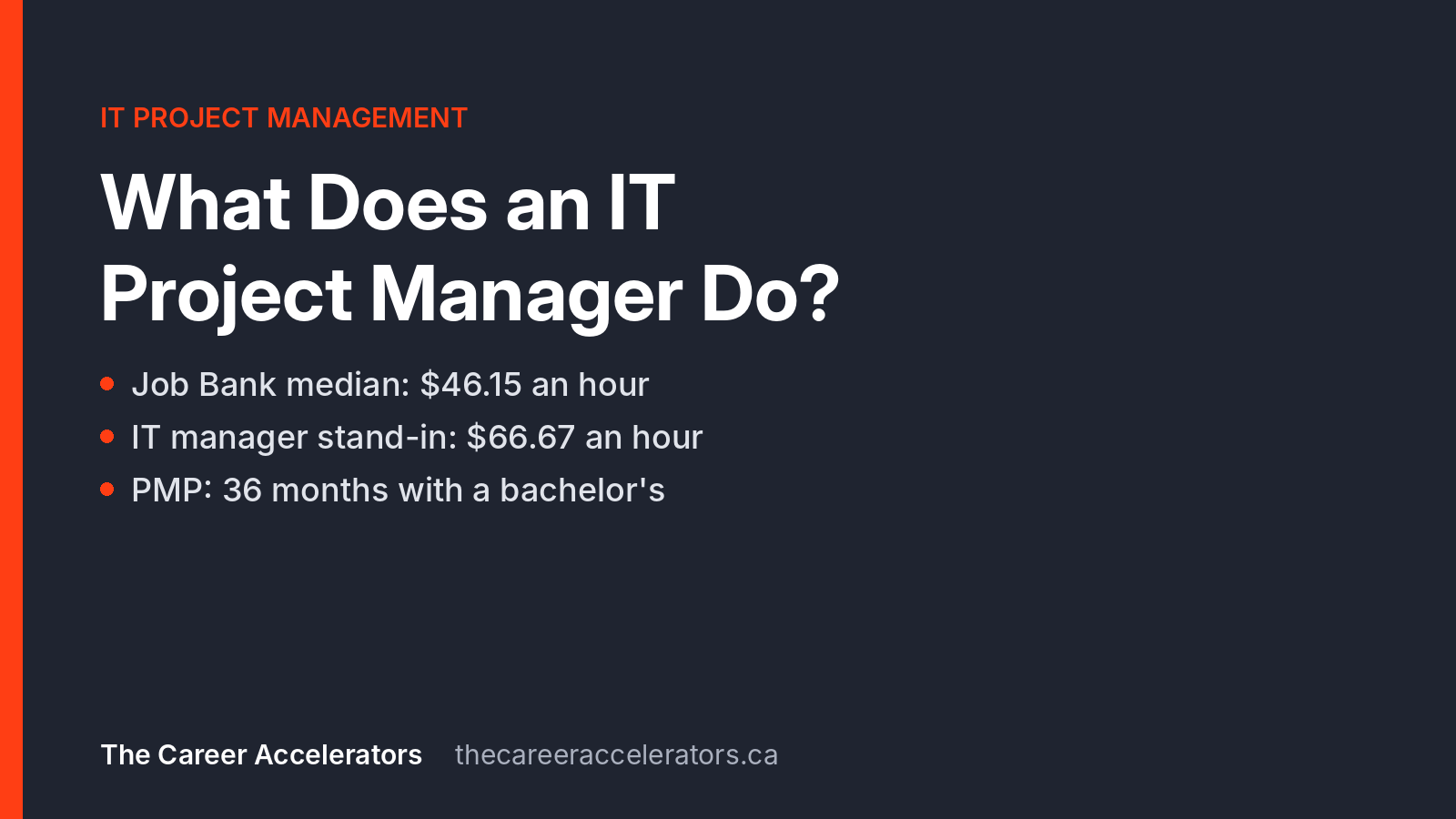
By Stephen Adindu, PMP, PRINCE2 Practitioner, Lead Coach at The Career Accelerators. Last updated November 2026.
An IT project manager plans and leads technology projects, such as software releases, cloud migrations, ERP or CRM rollouts and security upgrades, from the business case through go-live and handover to the people who will run the system. They don't write the code. They own the plan, budget, risks, vendors and communication, and make sure what the technical team builds lands safely with its users. In Canada, Job Bank's line for the exact job title shows a median of C$46.15 an hour, about C$90,000 a year, and IT managers who supervise staff earn more.
This guide covers what makes IT projects different, the work through a project's life, who you work with, Agile, hybrid and predictive delivery, the skills and certifications employers look for, pay, and the usual routes in.
Key takeaways
|
What does an IT project manager do?
An IT project manager is accountable for getting a technology change delivered: agreeing what it includes, planning it, leading the people who build and test it, and steering it through go-live. A typical week mixes planning with a lot of follow-up:
- Running a weekly status meeting and joining the team's stand-ups.
- Updating the schedule or release plan, the budget forecast and the RAID log (risks, assumptions, issues and dependencies).
- Chasing dependencies, such as environment access, a security approval or a vendor deliverable.
- Reviewing change requests with the business analyst and the sponsor.
- Preparing the status report or steering committee update, including the decisions you need.
- Clearing blockers so developers and testers can keep working.
What makes IT projects different from other projects?
Scope, time, cost and risk work as they do on any project. The difference is that much of the work stays invisible until it's tested, systems depend on each other in ways nobody wrote down, and the riskiest moment is go-live, when the new system replaces the old one while people still need to work.
| Project type | What you're managing | What to watch closely |
|---|---|---|
| Software releases | New features or fixes moving through development, testing and production | Scope creep between releases, squeezed test time, and a rollback plan if a release fails |
| Infrastructure and cloud migrations | Moving servers, data and applications to new hardware or a cloud platform | Hidden dependencies, downtime windows, data checks after the move, and switching off the old environment |
| ERP and CRM rollouts | Replacing finance, HR, supply-chain or customer systems, usually with a vendor or implementation partner | Data conversion, integrations, training and adoption, and the support period after go-live (often called hypercare) |
| Cybersecurity projects | Adding controls such as multi-factor authentication, security monitoring or access management | Changing security without disrupting the business, security team sign-off, and keeping sensitive details need-to-know |
Job Bank also lists "IT project manager - cybersecurity" as a separate title (NOC 21220, cybersecurity specialists; the wage covers the whole group).
What does an IT project manager do through a project's life?
Most IT projects pass through the same stages, whether the team works in sprints or phases.
| 1. Start up Agree the business case, sponsor, scope and delivery approach. Identify stakeholders and write the project charter. |
| 2. Plan Build the schedule or release plan, budget and resource plan. Book environments and vendor time, set up the RAID log and agree the test strategy. |
| 3. Build Track progress, manage dependencies and vendors, assess change requests and keep risks moving. |
| 4. Test Protect time for integration testing and user acceptance testing (UAT), run defect triage and agree what "ready" means. |
| 5. Go live Run the cutover plan, chair the go/no-go decision, tell users what's changing and keep a rollback plan ready. |
| 6. Hand over and close Support hypercare, hand the system to operations and the service desk, close contracts and budget, and record lessons learned. |
On Agile teams, planning, building and testing repeat in short cycles. Go-live and handover still need a plan.
Who does an IT project manager work with?
You rarely manage the people doing the work, so much of the job is agreeing what each group needs from you and you from them.
| Who | What they own | What you agree together |
|---|---|---|
| Developers and engineers | Building and fixing the solution | Estimates, priorities, blockers and what "done" means |
| Business analysts | Requirements, process changes and user stories | The scope baseline and how change requests are assessed |
| Product Owner and Scrum Master | Backlog order (Product Owner) and how well the team uses Scrum (Scrum Master) | How the release plan, budget and milestones fit the backlog |
| Testers, architects and security | Test plans, designs, standards and approvals | Enough review and test time in the plan, and the go/no-go criteria |
| Vendors and implementation partners | The work in their contract | Deliverables, deadlines, invoices and dependencies against the contract |
| Sponsor and steering committee | Funding and major decisions | Status, risks and the decisions you need from them |
The Scrum Guide defines a Scrum Team as one Product Owner, one Scrum Master and Developers; it has no project manager role. Where teams use Scrum, the IT project manager usually works around the team: budgets, dependencies between teams, vendors, release dates and sponsor reporting. Our post on Scrum Master vs project manager compares the two jobs.
Do IT project managers use Agile, hybrid or predictive delivery?
All three, often in the same organization. The approach should fit the work.
| Approach | How it works | Often a good fit for |
|---|---|---|
| Predictive (waterfall) | Requirements and design agreed up front, then phases with sign-offs | Infrastructure upgrades, regulated changes and fixed-scope vendor contracts |
| Agile (often Scrum) | Short cycles (in Scrum, sprints of one month or less), with scope adjusted as the team learns | Software products, digital services and internal tools |
| Hybrid | Fixed milestones, budget and approval gates, with Agile delivery inside them | ERP and CRM rollouts with a set go-live date, and programs mixing software and infrastructure |
Employers expect more than one: BC Assessment's senior project manager posting expected the role to use both traditional and agile approaches, and a Québec City posting included some Scrum Master duties. Since July 2026, the PMP exam is about 40% predictive and 60% agile or hybrid.
What skills and tools do employers ask for?
Four IT project manager postings advertised on Job Bank in September and October 2026 show what Canadian employers want, and what they pay.
| Employer and role | Pay offered | What the posting asked for |
|---|---|---|
| PHOENIXX, Québec City IT project manager |
$75,000 to $90,000 a year | 3 to 5 years' experience, a college diploma, Agile and Scrum, French |
| Horizon Canada, Ottawa IT project manager |
$48 an hour | 3 to 5 years' experience and a bachelor's degree or equivalent experience; on site |
| BC Assessment, Victoria Senior project manager |
$99,000.56 to $116,373.51 a year | Complex, high-risk IM/IT projects; charters, business cases, budgets, risks and third-party providers; both traditional and agile approaches |
| City of Coquitlam Senior ICT project manager |
$131,057 a year | A multi-year ERP implementation, vendor and implementation partner management, change management and executive governance |
Across these postings, the skills fall into three groups:
- Delivery: planning, budgeting, risk and issue management, change control and governance reporting.
- People: stakeholder management, managing vendors you don't employ, and resolving conflict between teams.
- Technical literacy: enough grasp of the software development life cycle (SDLC), test stages, environments, integrations, cloud and security to ask the right questions and judge estimates. You don't need to code.
The Job Bank versions of these postings didn't name tools such as Jira or MS Project, and tools vary by team. Expect Jira and Confluence on Agile teams, Microsoft Project or similar for phase-based schedules, SharePoint for documents and Excel for budgets and logs.
Which certifications help an IT project manager?
A certification isn't a licence to work, but it shows you know the method, which matters most when you're changing careers. Pick the one that matches your experience now.
| Certification | Eligibility | Exam | Keeping it |
|---|---|---|---|
| CAPM (PMI) Starting out |
A high school diploma and 23 contact hours of project management education. No experience needed. | 150 questions in 3 hours | 15 PDUs every 3 years |
| PMP (PMI) Experienced project managers |
Project leadership experience from the last 10 years: 36 months with a bachelor's degree, 48 with an associate's degree or vocational diploma, 60 with a high school diploma, or 24 with a degree from a PMI GAC-accredited program. Plus 35 hours of project management training, or an active CAPM. | 180 questions in 240 minutes, with two 10-minute breaks | 60 PDUs every 3 years |
| PRINCE2 7 Foundation (PeopleCert) | No prerequisites | 60 multiple-choice questions in 60 minutes, closed book, 60% to pass | Every 3 years: 60 CPD points, or pass another exam in the same suite |
| PRINCE2 7 Practitioner (PeopleCert) | One of: PRINCE2 7 Foundation; PRINCE2 6th or 5th edition Foundation or Practitioner; PMP; CAPM; PPQ; PMQ; IPMA Level A, B, C or D; CSPM-2 or CSPM-3 | 56 questions and sub-questions worth 70 marks, 150 minutes, open book, 60% to pass | Subject to renewal, with 60 CPD points |
| CSM (Scrum Alliance) Scrum teams |
A 16-hour course with a Certified Scrum Trainer. No experience needed. | 50 questions in 1 hour, 37 correct to pass; two attempts within 90 days included | Every 2 years: US$100 and 20 Scrum Education Units |
| PMI-ACP (PMI) Experienced Agile practitioners |
A high school diploma or higher, plus one of: 2 years of agile experience in the last 5; 1 year of agile experience with a degree from a PMI GAC-accredited program; 1 year with a third-party agile certification; or a PMP. Plus 21 hours of formal agile training. | 120 questions in 180 minutes, including one 10-minute break | 30 PDUs every 3 years |
One PMP rule to know: from 1 December 2026, PMI counts live, instructor-led training toward the 35 hours only if it comes from a PMI Authorized Training Partner, a China Registered Education Provider or an eligible accredited academic program. Self-paced courses that meet PMI's criteria can still come from any provider, and training completed before 1 December 2026 still counts under the rules that applied when you took it. Our step-by-step PMP guide covers the application and the new exam.
If you're new, the CAPM or PRINCE2 Foundation gives you the vocabulary without experience. An active CAPM also qualifies you for PRINCE2 Practitioner and covers the PMP's training requirement later. If the jobs you want mention Scrum, add the CSM. Once you have the months of project leadership, the PMP shows you've led projects, not just studied them.
How much does an IT project manager earn in Canada?
Job Bank has a line for the exact title: "Information Technology (IT) Project Manager", in NOC 21222, information systems specialists. Job Bank sets wages for each NOC occupation, so the figures cover the whole group, including systems analysts, IT consultants and QA analysts, not project managers alone.
Seniority alone doesn't change the group: Job Bank filed both senior postings above under this title, in NOC 21222. IT managers who supervise staff and control budgets fall in NOC 20012, computer and information systems managers, so the table also shows Computer Projects Manager (NOC 20012), a stand-in for IT managers who supervise staff. Figures are in Canadian dollars.
| Job Bank title (NOC) | Low ($/hour) | Median ($/hour) | High ($/hour) | Median a year |
|---|---|---|---|---|
| Information Technology (IT) Project Manager (NOC 21222, information systems specialists) | $28.85 | $46.15 | $68.68 | about $90,000 |
| IT Project Manager - Cybersecurity (NOC 21220, cybersecurity specialists; the wage covers the whole group) | $30.00 | $49.52 | $72.12 | about $96,600 |
| Computer Projects Manager (NOC 20012), a stand-in for IT managers who supervise staff | $43.75 | $66.67 | $103.37 | about $130,000 |
Source: Job Bank hourly wages, updated 19 November 2025, from Statistics Canada's 2023 to 2024 Labour Force Survey. Yearly figures assume 37.5 hours a week for 52 weeks.
The low and high figures are roughly the 10th and 90th percentiles, and they don't track experience, so they aren't entry-level or senior pay scales. Provincial medians for the IT project manager line sit close to the national one: $47.00 in Ontario, $48.08 in Alberta and $46.15 in British Columbia and Quebec.
PHOENIXX's mid-level role offered $75,000 to $90,000 a year, close to the IT project manager median. The two senior roles, both filed by Job Bank under the IT project manager title (NOC 21222), offered $99,000.56 to $131,057. That's above the line's median and below its high of about $133,900; only the top of that range reaches the Computer Projects Manager (NOC 20012) median of $66.67 an hour, about $130,000 a year.
How do you become an IT project manager?
Most people get there in steps. The mid-level postings above asked for three to five years of experience, and the NOC says IT managers who supervise staff (NOC 20012) need several years in areas such as systems analysis, software engineering or programming, including supervisory experience.
| Starting point | What already transfers | What to add |
|---|---|---|
| Project coordinator | Schedules, RAID logs, status reports and meetings | Ownership: run a workstream, then a small project end to end |
| Business analyst | Requirements, stakeholders, process change and UAT | Planning, budgets, risk and vendor management |
| QA or testing | Test planning, defect triage and release readiness | Planning beyond testing, budgets and sponsor reporting |
| IT support or infrastructure | Incidents, change management and how the systems fit together | Formal planning, business cases and leading people you don't manage |
| Non-IT project manager | Planning, budgets, risk and stakeholders | The SDLC, Agile, testing and go-live, and a first IT project to point to |
Project coordinator is the most direct route, because you're already on IT projects and can take on more of the plan as you go. Our guide to what a project coordinator does covers that first step.
If you're in another IT role, start with your current employer. Ask to own one workstream on the next rollout or upgrade, such as data migration, training or cutover, and keep the plan, RAID log and go-live checklist as evidence of project leadership.
How we prepare IT project managers at TCA
Our project management course runs live and online over 12 weeks, and no prior IT experience is required. Practising senior project managers teach the project lifecycle using the SDLC, Waterfall and Agile and how to choose between them, stakeholder tools such as the RACI matrix and power/interest grid, RAID management, status reporting and change requests.
It includes a 12-week live project where you work as a Project Coordinator or Project Manager on projects such as CRM systems, ERP systems and e-commerce platforms, using tools including MS Project, Jira, Confluence, SharePoint and Trello. You also get one-on-one mentorship, a CV review and interview preparation. The self-paced part of the course counts toward your 35 hours of PMP training: it gives you all 35 hours, with a completion certificate that shows them. The course also includes PMP practice questions, full exam simulations and help with your PMP application.
One TCA student moved from a non-tech admin job to a government project manager role in Canada. Read Oluwakemi's story.
IT project manager FAQs
Do I need a technical background to become an IT project manager?
You don't need to code, but you do need to understand how systems are built, tested and released, so you can judge estimates and spot risks. Many people learn this as a coordinator or in another IT role.
Is the PMP required?
Not to work in the role. It's a professional certification, not a licence, so check what each posting asks for. With a bachelor's degree it needs 36 months of project leadership, so many people start with the CAPM or PRINCE2 Foundation.
How much does an entry-level IT project manager earn?
Job Bank doesn't publish pay by experience. The low figure for its IT project manager line, $28.85 an hour (about $56,300 a year), is in most cases the 10th percentile for the whole occupational group, not a starting salary; Job Bank says low figures may give some insight into some entry-level pay. Project coordinator roles are the more common first step.
Can IT project managers work remotely?
Partly, in some roles. Of the four Job Bank postings above, three were hybrid and one was on site only. None was fully remote, though that's a small sample.
Is a technology project manager the same as an IT project manager?
Usually. The postings above were titled IT project manager, senior ICT project manager and senior project manager (for IM/IT projects), and the NOC also lists technical project manager, so read the duties rather than the title.
Stephen's tip: If you're a business analyst, tester or support analyst, ask to own one workstream on your next system rollout, such as data migration, training or cutover. Keep the plan, the RAID log and the go-live checklist: they become evidence of project leadership for your CV and, later, your PMP application.
Ready to start your IT project management career?
Our project management course combines live training, a 12-week live project as a Project Coordinator or Project Manager, and CV and interview support. Book a free call and we'll look at which route fits your experience.
Related reading: what a project coordinator does, how to become a project manager and why risk management matters in project management.
Sources
- Job Bank wages: IT Project Manager, IT Project Manager - Cybersecurity and Computer Projects Manager, for wages and NOC codes; wage methodology, for what the figures mean
- NOC 2021: 21222 and 20012, for job titles, duties and experience requirements
- Job Bank postings from PHOENIXX, Horizon Canada, BC Assessment and the City of Coquitlam (advertised September and October 2026), for duties, requirements, pay, work arrangements and the NOC each was filed under
- The Scrum Guide, for Scrum Team accountabilities and sprint length
- PMI: PMP, for the eligibility paths and exam length (as cited in our PMP guide); the updated PMP exam, for the 10-year experience window and the live-training rule; the 35-hour training requirement, for the 1 December 2026 date; the PMP Examination Content Outline (July 2026), for the predictive and agile split
- PMI: CAPM, PMI-ACP and the CCR Handbook (April 2026), for CAPM and PMI-ACP rules and PDUs
- PeopleCert: PRINCE2 7 Foundation and PRINCE2 7 Practitioner, for prerequisites, exams and renewal
- Scrum Alliance: Becoming a Certified ScrumMaster and renewing certifications, for the CSM course, test and renewal
